

Last updated: November 1, 2026.
A purchasing manager types into ChatGPT: “We need to fill 3,000 bottles of a foaming product a day. Which manufacturers in Turkey should I look at?” A few seconds later, a shortlist of three or four companies appears. In those few seconds the model does a series of things, and most of them decide what you need to fix on your own site.
Knowing the mechanism pays off in practice. Advice like “break your content into small chunks,” “create a page for every question” or “get to #1 in AI” gets passed around a lot, and most of it is written without understanding how answers are built. Once you know how the answer is put together, you can tell for yourself which advice works and which is a waste of time.
I won’t go into model architecture. What a marketing manager, a site owner or an SEO needs to make decisions is enough.
1. Memory and live search
An AI model can answer a question from two places.
The first is its memory, meaning its training data. During training the model reads an enormous amount of text and builds general knowledge about language, topics and brands. That knowledge freezes at a cutoff date, and the model can’t know what happened after it from memory alone. It also doesn’t store what it read word for word; it learns patterns from the text. So an answer from memory can’t cite a source, and what the model knows about your brand depends on how much, and how, you appear in its training data.
The second is live search. If a question needs current information, a price, an address or a product comparison, the model searches the web, reads what it finds and writes the answer from that. OpenAI describes it this way for ChatGPT: “ChatGPT will choose to search the web based on what you ask.” The model decides whether to search based on your question (OpenAI). Google’s AI Overviews and AI Mode, on the other hand, always ground their answers in pages from Google’s search index.
The two sources mean different things for a business. Live search is the short-term side and the one you control. A page you publish, fix or get indexed today can show up in AI answers within a few days, and the foundation from Chapter 2 is what this side runs on. Training data is the long-term side. What has been written about your brand on the web over the years, and how it’s described on which sites, gets reflected in the model’s memory at the next model update. We’ll come back to that in Chapters 13 and 14, on brand and third-party sources.
Which one kicks in depends on the question. A model can answer “What is a filling machine?” from memory, because the answer barely changes over time. “I need to fill 3,000 bottles of a foaming product a day, which manufacturers in Turkey should I look at?” asks for current, commercial information, and for questions like that the model will most likely search.
That’s good news for businesses. Most of the questions closest to a sale need current information, so they go to search. On the questions that matter most for your business, the side you can influence is the one at work.
2. The answer is built on search results
The technical name for an AI answering with search is RAG (Retrieval-Augmented Generation). Google calls the same thing grounding. The model retrieves information first and then writes based on it. Roughly, it goes in six steps:
- The model works out what the question is asking and what information it needs.
- It turns the question into one or more search queries. This is the step called query fan-out.
- It retrieves pages from the results of those searches.
- It reads those pages and picks the passages relevant to the question.
- It writes the answer from those passages, in its own words.
- It links to the pages that support the answer.
For a site owner, step three matters most. Google states plainly that it uses its core ranking systems to retrieve pages for its AI features: “relying on our core Search ranking systems to retrieve relevant, up-to-date web pages from our Search index” (Google Search Central). The pages AI reads come from among the pages that rank well in classic search.
That’s also why Chapter 2 is as long as it is. The model doesn’t read the internet from end to end. It reads a limited number of pages for each question, and search rankings decide which ones. A page that isn’t crawled, isn’t in the index or can’t be found for the relevant searches won’t be read, no matter how well it’s written.
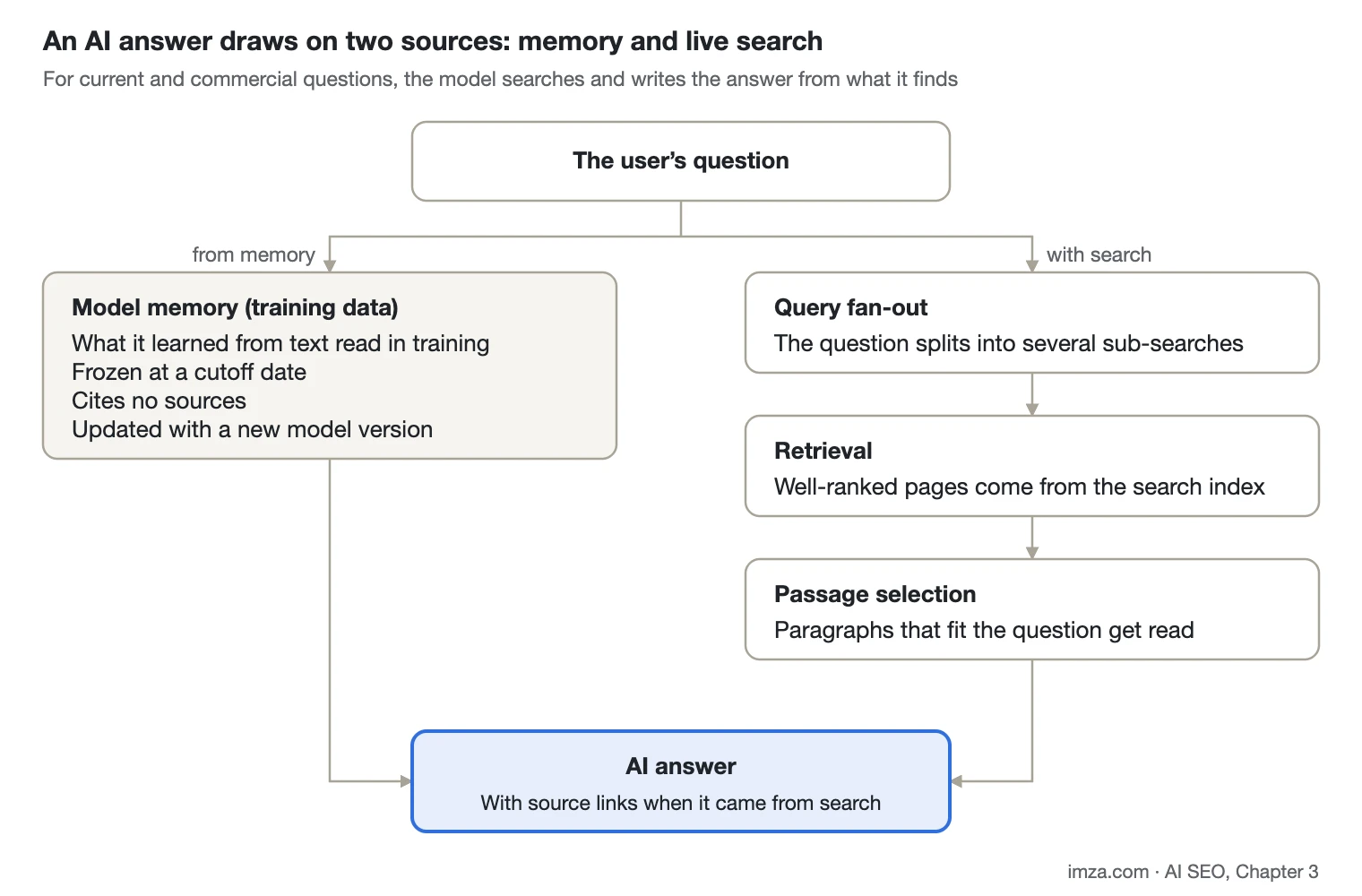
The left path is the model’s memory, the side you can’t influence in the short term. The right path is live search, where the foundation from Chapter 2 and the steps in this chapter do their work.
3. One question, many searches
We touched on query fan-out briefly in Chapter 1. It’s the biggest difference between AI search and classic search, so it deserves a closer look.
Google defines query fan-out as “A set of concurrent, related queries generated by the model to request more information.” In Google’s own example, for a user whose lawn is overrun with weeds, the model also runs a search like “best herbicides for lawns” in the background (Google Search Central).
Robby Stein, Google’s VP of Product for Search, shared a few details about the process in July 2025 (Search Engine Journal). The model also searches for topics the user never asked about but that relate to the question. For someone traveling to Nashville with a big group, it might search separately for restaurants, bars and things to do with kids. It doesn’t only look at web results; it also checks real-time data sources such as the Shopping Graph. According to Stein, that product catalog holds about 50 billion products and is updated about 2 billion times an hour. For questions that need deeper research, Deep Search can run dozens or even hundreds of searches in the background, which can take a few minutes.
Back to the filling machine. The user asks: “I need to fill 3,000 bottles of a foaming product a day. Which machine should I buy?” In the background, the model might split that into searches like these:
- how to fill foaming liquids
- difference between diving nozzle and piston filling machines
- filling machine with 3,000 bottles a day capacity
- filling machine prices
- filling machine manufacturers in Turkey
- filling machine service and spare parts
I made up these searches as an example. Neither Google nor OpenAI shows site owners which searches actually run. The logic holds, though: one question from the user becomes several searches, each with its own results page.
The first consequence is that ranking high for the main keyword is no longer enough. You can rank first for “filling machine” and the model may still write its answer from a competitor’s page that shows up for “how to fill foaming liquids.” The Ahrefs data from Chapter 1, showing that a large share of pages cited in AI Overviews aren’t in the top 10 for the main query, is largely explained by this.
That doesn’t mean you should create a separate page for every sub-search. Google gives a clear warning here. Producing separate content for every possible variation of a query can be tempting, but if you do it mainly to manipulate rankings or AI answers, you may violate the scaled content abuse policy (Google Search Central).
The right work is more tedious but sturdier. List the sub-questions a buyer will ask while deciding, check whether your existing pages answer them, and fill the gaps. If a sub-question really is a separate need, such as a technical comparison or a capacity calculation, it will naturally need its own page anyway. How to find these questions is the subject of Chapter 6.
4. The model picks part of a page
Not every retrieved page makes it into the answer. The model picks the passage from each page that best fits the question and builds the answer from those passages. In classic search a page ranked as a whole. In an AI answer, what competes is often a paragraph, a table row or a definition inside the page.
Google also says its systems can tell apart several topics on one page and show the user the relevant part (Google Search Central).
This gets misread a lot. “If AI reads paragraphs, I’ll split my content into small chunks” was popular advice throughout 2025, and Google pushed back on it openly. On Google’s Search Off the Record podcast in January 2026, Danny Sullivan said of the advice to break content into bite-sized chunks for AI: “We don’t want you to do that” (Search Engine Land). Google’s guide says the same thing: you don’t need to break content into small pieces so AI understands it better, and there’s no ideal page length.
What works is what a well-written page already does. Each paragraph should carry its own context. “This machine fills 3,000 bottles a day” doesn’t say which machine when read on its own; “The X-200 filling machine fills 3,000 bottles a day” still makes sense when pulled out of the paragraph. When facts like capacity, price range, lead time, warranty and service area are written out clearly with numbers, AI is more likely to relay them correctly.
Headings should also describe what’s under them. A heading like “Filling speed for foaming products” instead of “Details” tells both the reader and the model what the paragraph answers. Giving the answer in the first sentences of a section and the detail afterward does the same job.
None of this is a new technique. Good editors have been saying it for years. Chapter 10 covers readable, quotable pages in detail.
5. Mentioned, recommended and cited
The model doesn’t paste the passages it picked one after another. It reads them, writes new text in its own words and links to the pages that support the answer. Google describes this as showing prominent, clickable links to the pages that support the answer. In ChatGPT, the Sources button under the answer lists the pages used (OpenAI).
A brand can appear in that answer in three ways. Its name can come up: “In Turkey there are manufacturers such as X, Y and Z.” It can be recommended for a specific need: “For foaming products, X’s diving nozzle models are a good fit.” Or its page can be linked as a source.
These three can happen independently. Your guide on how to fill foaming liquids can be cited while competitors make the recommendation list in the same answer. The reverse happens too: your brand gets recommended, but the link goes to a comparison site or an industry directory.
For business results, I think being recommended is the most valuable. As I said in Chapter 1, AI traffic for our clients is small but converts at a high rate. One reason is that by the time users reach the site, they’ve already built a shortlist from the AI’s recommendation. Citations bring traffic and mentions bring awareness, but sales usually come from recommendations. I’ll explain how to measure the three separately in Chapter 7.
6. Same question, different answers
Ask an AI the same question twice and you’ll most likely get two different answers. The model writes by picking each word from a probability distribution, so it isn’t expected to give the same answer word for word. Query fan-out may not come out the same each time either, and different sub-searches mean different pages get retrieved. Search results don’t stand still: new pages get indexed, rankings shift, prices and stock change.
Then there’s context. Location, language, earlier messages in the conversation and what the model remembers about the user all affect the answer. With Personal Intelligence, which I mentioned in Chapter 1, Google can also bring information from apps like Gmail and Photos into the answer for users who allow it.
One of the best studies on how much answers vary came from SparkToro and Gumshoe. In November and December 2025, Rand Fishkin and Patrick O’Donnell ran 12 different recommendation prompts hundreds of times across ChatGPT, Claude and Google’s AI features, 2,961 runs in total (Search Engine Journal). The chance of getting the same brand list twice for the same question was under 1%. The chance of getting the same list in the same order was about 1 in 1,000.
Some brands, though, were very consistent. In headphone questions that participants wrote in their own words, none of them alike, Bose, Sony, Sennheiser and Apple appeared in 55% to 77% of 994 answers.
Fishkin calls any tool that gives a “ranking position” in AI “full of baloney.” In his view, the meaningful measure is how often you appear across many runs.
There’s no #1 in AI, only a rate of appearance. When a client says they asked ChatGPT once and didn’t see their brand, that alone tells you nothing. You need to ask different questions with the same intent on different platforms, many times, and count how many answers you appear in. I’ll walk through the method in Chapter 7.
7. Wrong answers sound just as sure
Because the model writes the answer in its own words, it can state wrong information with the same confidence. Either it relies on a wrong or outdated source, or it produces information that isn’t in any source. The second is called hallucination.
A study published by Columbia University’s Tow Center in March 2025 shows the size of the risk (Nieman Lab). Researchers gave eight AI search tools excerpts from news articles and asked for each article’s headline, publisher, date and URL, 1,600 queries in total. The tools failed to find the correct information in more than 60% of cases. The best result was Perplexity with a 37% error rate; the worst was Grok 3 at 94%. Most tools stated wrong answers confidently; only 15 of ChatGPT’s 134 wrong answers included any hedging. Some tools made up links that didn’t exist.
The study looked at news sources and measured the tools as they were in early 2025, so results may differ today. The warning for brands still stands. Not everything AI says about your brand is necessarily true.
The most common risks for brands are outdated prices, a closed branch or a changed address, a discontinued product, wrong technical specs and the brand being confused with a competitor. In Chapter 1 I called the case where AI recommends you but describes you wrong the most dangerous one.
What you can do:
- Keep prices, addresses, opening hours and product specs on your site in one place, clearly written and up to date.
- Update, redirect or remove pages for ended campaigns, discontinued products or outdated information. The indexing decisions from Chapter 2 apply here too.
- Make the information on your Google Business Profile, industry directories, marketplaces and social media profiles match your site.
- Ask about your brand, products and prices on different platforms at regular intervals and save the answers.
Chapters 13 and 14 cover brand and third-party sources in more detail.
8. Applying the chain to your site
An AI answer looks like a black box from the outside, but the chain isn’t hard to follow: split the question into searches, retrieve pages, read the relevant passages, write in its own words, cite sources. Because retrieval relies on classic search, nothing else works without the foundation from Chapter 2. Because of the sub-searches, your pages also need to answer the questions buyers ask while deciding, without a separate page for each one.
Answers change every time, so making decisions from a single screenshot is misleading. And when the model says something wrong about your brand, the cause is usually outdated or inconsistent information on the web.
This chain isn’t built from the same parts on every platform. Google, ChatGPT, Perplexity and Copilot read from different indexes and put links in different places, and Chapter 4 is about those differences.
Checklist
| Check | Where to look | Why it matters |
|---|---|---|
| Key pages show up for the main searches and related sub-searches | Search Console queries, manual searches | The model pulls the pages it reads from search |
| Main product and service pages answer the sub-questions buyers ask when deciding | Compare with the questions your sales team hears most | Query fan-out pulls sources from sub-questions |
| No separate page was created for every sub-question | Sitemap and content inventory | Google can treat it as scaled content abuse |
| Paragraphs carry their own context | Read a paragraph on its own | The model uses passages, not whole pages |
| Capacity, price, lead time, region and similar facts are written out with numbers | Page content | Concrete facts get relayed correctly |
| No pages with outdated prices, addresses or product details | Content inventory, site search | The model repeats outdated facts with confidence |
| Off-site profiles match the site | Google Business Profile, directories, marketplaces | Inconsistent facts lead to misrepresentation |
| The brand is checked regularly on different platforms with different prompts | ChatGPT, Gemini, AI Mode, Copilot, Perplexity | Answers vary; a single check is misleading |
Sources
- Google Search Central: Optimizing for generative AI search (last updated July 10, 2026)
- OpenAI: Introducing ChatGPT search (October 31, 2024)
- Search Engine Journal: Query fan-out technique in AI Mode, new details from Google (July 30, 2025)
- Search Engine Land: Google doesn’t want you to create bite-sized chunks of your content (January 2026)
- Search Engine Journal: AI recommendations change with nearly every query (SparkToro) (January 30, 2026)
- Nieman Lab: AI search engines fail to produce accurate citations in over 60% of tests (March 10, 2025)
Previous: Chapter 2, The SEO Foundation You Need for AI Search · Table of contents · Next: Chapter 4, Not All Platforms Are the Same