
Last updated: November 1, 2026.
A filling machine manufacturer can call itself “the industry leader” on its own website. AI will read that line, but it won’t lean on it much. What carries weight in the answer is how a trade magazine, a forum thread and two hundred customer reviews describe the same company.
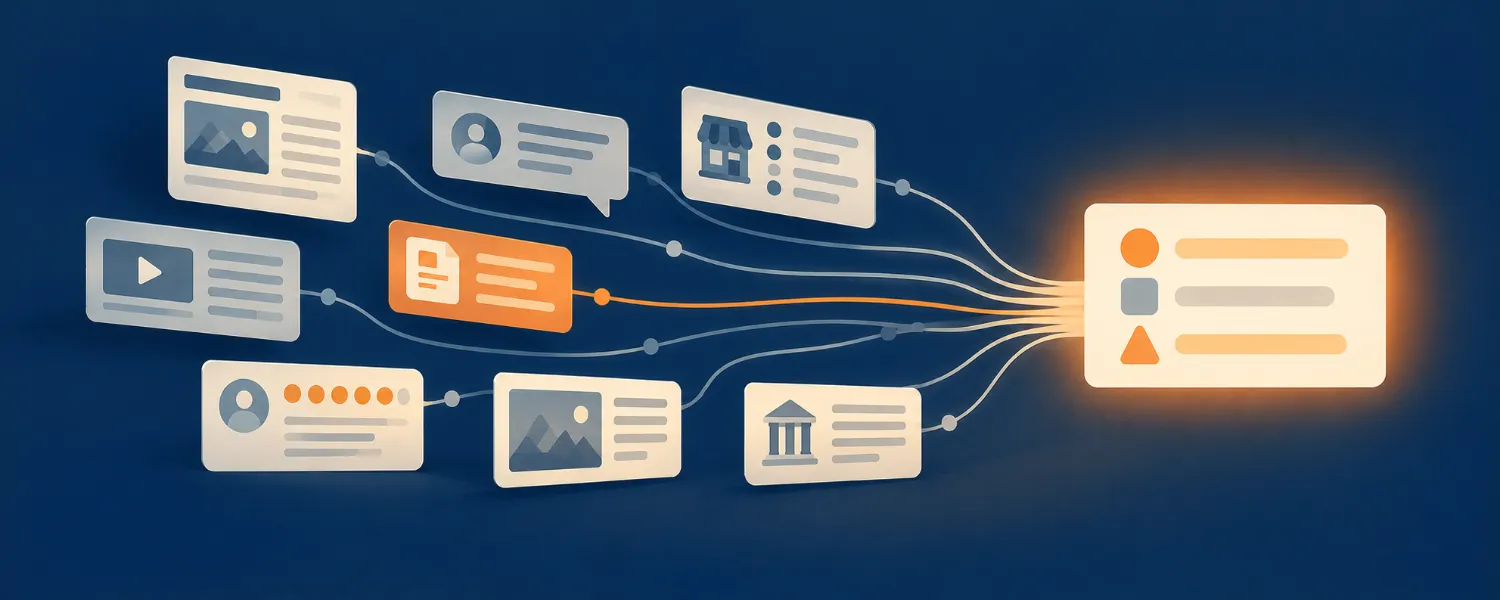
In Chapter 1 I put it in one sentence: AI learns about you not only from your website, but from Reddit, YouTube, complaint sites, the news and your competitors’ comparison pages. Chapter 13 was about how a brand describes itself. This chapter is about how other people describe you.
The awkward part is that most of these sources aren’t yours. You can’t edit a forum post, a review on a complaint site or someone else’s YouTube video. What you can do is join those conversations under your own name, respond to complaints and do things worth writing about. Most of the advice below comes back to one of those three.
1. Which sites does AI cite most?
The most current data comes from Ahrefs, which updates its lists every month. Ahrefs tracks which sites each platform cites across a large set of US prompts and calculates each site’s share among the most-cited domains. Here are the top three in the September 2026 data:
| Platform | #1 | #2 | #3 |
|---|---|---|---|
| AI Overviews | YouTube (22.9%) | Reddit (18.5%) | Facebook (10.1%) |
| AI Mode | Reddit (17.9%) | YouTube (17.8%) | google.com (12.5%) |
| ChatGPT | Reddit (16.8%) | Wikipedia (7.0%) | Consumer Reports (3.7%) |
| Perplexity | Reddit (21.6%) | YouTube (20.8%) | Wikipedia (6.3%) |
Sources: Ahrefs lists for AI Overviews, AI Mode, ChatGPT and Perplexity, September 2026, US.
The percentages are each site’s share of citations among the most-cited sites, not of all citations, and the gap can be large. In Profound’s analysis of 680 million citations between August 2024 and June 2025 (Profound), Wikipedia held 47.9% of citations among ChatGPT’s top 10 cited sites. Its share of all ChatGPT citations was 7.8%.
Both things are true. Reddit, YouTube and Wikipedia sit near the top on almost every platform. Yet most citations are still spread across a long list of other sites: manufacturers, trade publications, guides, comparison sites, forums.
Nearly all of this data comes from the US and from English-language prompts, so it doesn’t carry over directly to Turkish queries. To see which sites stand out for Turkish questions, you’ll need to run the method at the end of this chapter yourself.
2. Why other people’s word counts for more
A brand always says good things about itself. That’s why an independent source carries more information.
Google teaches its quality raters the same logic. The rater guidelines ask raters to research the reputation of a website and its content creator, meaning what independent outside sources say about them. When what a site says about itself conflicts with what reputable independent sources say, the rater should trust the independent sources (Google Search Quality Rater Guidelines).
The guidelines also show how to do it. Using IBM as the example, they suggest searches that exclude the brand’s own site, such as “ibm -site:ibm.com” or “ibm reviews -site:ibm.com”. They also note that social media accounts run by the brand don’t count as independent sources.
Run the same search for your own brand. Type your brand name into Google and add “-site:yoursite.com”. The results are a rough list of the independent sources a rater, and very likely an AI, would read about you. Then repeat the search with words like “reviews”, “complaints” and “is it reliable”.
AI models don’t work by reading the rater guidelines, of course. The logic is similar, though. A brand calling itself “the industry leader” on its own site is a claim. Three independent trade publications, hundreds of customer reviews and a forum thread saying the same thing is evidence. When AI recommends a brand, it prefers to rest on evidence.
3. These lists move a lot
Citation lists can turn over within a few weeks. The most striking example came in September 2025.
Semrush tracked more than 100 million AI citations weekly between July 14 and October 12, 2025 (Semrush). In early August, Reddit was cited in about 60% of ChatGPT answers. By mid-September, that was down to around 10%. Wikipedia fell in a similar way, from about 55% to under 20%. AI Mode and Perplexity showed no shift that sharp over the same period.
The cause is disputed. Some SEOs tied it to Google removing a search parameter around the same time. Sergei Rogulin of Semrush thinks the real reason may have been ChatGPT trying to rely less heavily on particular sites. We don’t know for sure.
The practical lesson is clear enough. A plan built on “if we show up on Reddit, we’ll show up in ChatGPT” lost most of its effect within a few weeks in September 2025. A strategy that leans on a single platform or a single source can lose its value overnight. That’s the reason to spread your presence across sources.
4. Forums and Reddit
Reddit’s prominence in AI answers starts with licensing deals. On February 22, 2024, Google announced an expanded partnership with Reddit that gave it access to Reddit’s Data API (Google). According to Google, that access lets it better understand Reddit content and “display, train on, and otherwise use” it. OpenAI announced a similar deal on May 16, 2024, saying it would bring Reddit content into ChatGPT (OpenAI).
The nature of the content matters too. On forums, people write about what happened after they used a product: “I’ve had this machine for two years, and this part keeps breaking.” That’s the forum version of the first-hand experience from Chapter 12, and AI can look at posts like this when it evaluates a product.
Reddit isn’t nearly as widespread in Turkey as it is in the US. Turkish forums and sözlük sites such as Ekşi Sözlük and DonanımHaber have played part of that role for years. How often they’re cited in Turkish AI answers is something you can only find out by testing your own prompts.
If people are talking about your brand on forums, here’s a sensible way to handle it:
- Listen first. Follow threads that mention your brand and your category: which questions come up, which complaints repeat, how competitors are discussed.
- If you answer as a company representative, say so. Praising yourself from a fake account costs the brand far more than it gains once it comes out.
- Give the technical answer instead of a sales pitch. If a competitor’s product suits the job better, say that too. That’s how trust is earned on a forum.
- Every forum and subcommunity has its own rules on promotion. Read them before you post.
Google’s AI guide also says its AI features can surface what people say about products in blogs, videos and forum discussions, but that chasing artificial “mentions” isn’t as useful as people think (Google Search Central). Fake forum reviews are that kind of mention.
5. YouTube
YouTube is one of the standout names in the table. In the September 2026 data, it’s the most-cited site in AI Overviews and second in AI Mode and Perplexity. The Ahrefs study I mentioned in Chapter 1 also found that a large share of the pages cited without ranking in the top 100 were YouTube videos.
That’s an opening for brands that sell products and know their technical subject, because you don’t need millions of views. A video that’s the best answer to a question can be cited even if few people have watched it.
A filling machine manufacturer’s channel could include a test video showing foaming liquid soap being filled on the machine, a comparison of piston and overflow filling using real products, a step-by-step installation video and a short service video on fixing a common fault. None of these needs a big production. All of them are the video version of the content from Chapter 12 that competitors can’t copy.
A few basics help videos get found:
- Make the title state the question the video answers. Instead of “Promo video 3”, something like “Filling foaming liquid soap: how many bottles a minute without overflow?”
- Don’t leave the description empty. Summarize the video in a few paragraphs, include the key numbers and link to the relevant product page.
- Use the video on your own site too. Add it to the related product or guide page and write the same information out as text. Google’s guide also recommends supporting text content with high-quality images and videos.
Other people’s videos matter as much as yours. If a creator in your category reviews your product, that video is also a source AI can read. Sending a product to a creator and asking for an independent review is legitimate, but there are two limits. Google’s spam policy lists sending someone a product in exchange for a post that includes a link as an example of link spam. And the influencer guidelines Turkey’s Ministry of Trade published in May 2021 require commercial collaborations to carry a disclosure such as #Reklam (#Ad), #İşbirliği (#Collaboration) or “received as a gift from @” (Webrazzi). A clearly disclosed collaboration holds up far better than a hidden one, both legally and in terms of trust.
6. Complaint sites
In Turkey, complaint sites are one of the first places people check when researching a brand, and the biggest is Şikayetvar. According to figures the company shared in February 2026, the platform gets more than 20 million visits a month, and more than half a million complaints were resolved in 2025 (DHA).
When someone asks “Is Örnek Dolum reliable?”, “How is Örnek Dolum’s service?” or “Has anyone bought from Örnek Dolum?” about our hypothetical filling machine company, the model may look at sites like this. As of November 1, 2026, Şikayetvar’s robots.txt has no rule that specifically blocks AI bots. As we saw in Chapter 2, that alone doesn’t guarantee bots can get in, but nothing is blocked on the robots.txt side.
A Turkish regulation helps here. The February 1, 2022 amendment to the Ministry of Trade’s Regulation on Commercial Advertising and Unfair Commercial Practices placed several obligations on complaint platforms (Resmî Gazete):
- Complaint platforms must give the seller named in a complaint at least 72 hours to explain or respond before the complaint is published.
- This right of reply can’t be tied to membership or a fee.
- Once the consumer’s problem is resolved and verified, that is published promptly in the same place as the original review.
This gives a brand the chance to respond to a complaint before it goes live. Using it doesn’t take much:
- Assign a person or team to watch notifications from complaint platforms. 72 hours isn’t long.
- Reply to every complaint calmly and specifically. Instead of boilerplate like “Dear valued customer, we apologize for any inconvenience,” say what happened and what you’ll do about it.
- When you fix the problem, make sure the fix shows on the platform.
- If many complaints are about the same thing, fix it in the business, not on the complaint site. Then explain the fix clearly on your own website.
When answering “Is this brand reliable?”, AI may look not only at the number of complaints but at how they were answered and whether they were resolved. A list of unanswered complaints and a list where every complaint got a resolution can produce very different answers to the same question.
7. Google reviews and Business Profile
For local businesses and brands with physical stores, Google Business Profile and its reviews are among the most influential third-party sources. Google’s AI guide says products like Merchant Center and Business Profile can help your products and services appear both in AI answers and in other search results (Google Search Central).
The rules on reviews are clear. Google Maps’ contribution policy says contributions should reflect a genuine experience at a place or business (Google Maps). The policy prohibits:
- content not based on a real experience,
- reviews and ratings paid for directly or indirectly,
- content posted by one person from multiple accounts, or by others on their behalf,
- offering incentives such as payment, discounts, free products or services in exchange for reviews.
Turkish regulation points the same way. The same amendment banned making agreements with, or buying services from, a person or company to post untrue reviews to boost sales of a product or service. Under the same amendment, only people who bought the product or service can leave reviews on online sellers’ and marketplace platforms’ sites, and reviews must be published for at least one year, without separating positive from negative, sorted by an objective criterion such as date or rating.
Google and Turkish law both explicitly forbid buying reviews. What you can do is simple:
- Ask real customers for reviews. Send a short message with the review link after delivery, installation or service, with no incentive.
- Reply to every review: a short thank-you for positive ones, a specific explanation for negative ones.
- Watch for recurring themes. If the same complaint shows up in ten reviews, the problem is in the business, not in the reviews.
- Keep profile details current: opening hours, address, phone, services. The consistency rule from Chapter 13 applies here too.
8. Marketplaces and comparison sites
Marketplaces like Amazon, Walmart and eBay are also near the top of Ahrefs’ AI Mode list. For product questions, AI can pull product details, prices and user reviews from these sites.
In Turkey, that role belongs to marketplaces such as Trendyol, Hepsiburada and Amazon Turkey, and to price comparison sites such as Akakçe and Cimri. Your product pages there aren’t under your control, but they still tell AI about you.
If a marketplace listing has an outdated spec, a wrong measurement or an old image, AI may use it. Discontinued products can stay listed as available on dealers’ and resellers’ pages for a long time. Marketplace Q&A sections are another source of the customer questions from Chapter 12, so questions there shouldn’t go unanswered.
Comparison and list content such as “Top 10 filling machines” from competitors and independent sites belongs in this group too. AI can use these lists for “best” questions. If you’re missing from them, or listed with wrong information, contacting those sites with accurate details is legitimate. Paying to move up a list is a different matter; I’ll come back to it under Digital PR.
How product data reaches AI directly, through product feeds and shopping agents, is the subject of the next chapter.
9. Trade press and news
According to a Muck Rack report published in May 2026, based on more than 25 million links in ChatGPT, Claude and Gemini answers, 84% of cited links come from sources Muck Rack classifies as “earned media” (AI Magazine). Journalism makes up 27% of all links. Paid and promotional (advertorial) content accounts for just 0.3%.
Muck Rack sells PR software and defines “earned media” itself, so read the numbers with that in mind. Still, the report’s main message fits the other data: AI answers rely more on what independent sources write than on what a brand says about itself.
For B2B brands, the independent source is usually trade press rather than general news sites. For a filling machine manufacturer, that means packaging and food industry magazines, industry association publications, trade fair catalogs and engineering sites. They can look small. But for a question like “companies in Turkey that make filling machines for foaming products,” they may be among the few independent sources AI can find.
Getting into these publications doesn’t take a big PR budget, because most of them need concrete information from people in the industry. You can pitch trade magazines a technical article on solving a problem rather than a product promotion. Check that your details are correct in the directories of associations you belong to and on the exhibitor pages of fairs you attend; those pages stay online for years. Do joint case studies with customers and suggest publishing them on the customer’s own site or in a trade publication. A success story told by the customer is a stronger source than one told by you.
10. Digital PR
Digital PR is work aimed at getting your brand mentioned and linked on other sites, especially news and trade publications. In classic SEO it was mostly about backlinks. In AI search, its real value is getting your brand described accurately by independent sources.
In Chapter 13 we looked at Ahrefs’ study of 75,000 brands: the number of web mentions correlated with AI Overviews visibility far more strongly than the number of backlinks did. That’s why digital PR has gained value.
What journalists and editors want hasn’t changed: something newsworthy. That usually means one of these:
- Original data: industry data, a survey or your own measurements (Chapter 12). Data like “filling line investments by Turkish cosmetics manufacturers” is something a trade magazine can report on.
- A clear comment from your engineer or a manager on a development in your industry.
- A real development: a new factory, a new product, an export win, a certification.
- A useful resource others will want to link to: a calculator, a guide, a checklist.
What does harm is just as clear. Google’s spam policies list these among the examples of link spam (Google Search Central):
- buying or selling links to manipulate rankings, including paying money, products or services for them,
- sending someone a product in exchange for a post that includes a link,
- paid advertorials containing links that pass ranking credit,
- keyword-optimized anchor text in articles distributed on other sites, guest posts or press releases.
One practice is very common in Turkey: paying news sites to publish “news” stuffed with keyword-anchored links. By Google’s definition, that’s link spam. I don’t think it does much for AI either, because these pieces usually sit in a site’s “sponsored” section where nobody reads or quotes them. If you do pay for content, the links in it need to be marked as sponsored, as Google requires.
11. LinkedIn and the expert’s own voice
For B2B brands, LinkedIn deserves its own mention. In the same Semrush study, AI Mode cited LinkedIn in about 15% of answers throughout the tracking period, and LinkedIn’s share in ChatGPT and Perplexity also grew after September 2025 (Semrush).
A post your founder, engineer or sales manager writes on LinkedIn, drawing on their own experience, can be a source AI reads. The people behind the brand, from Chapter 13, come in handy here. An answer to an industry question in the voice of a named expert at the company is more convincing and easier to quote.
Promotion won’t do it here either. “Our new machine is out” is an announcement. A post titled “Three things that determine filling speed for foaming products,” written with examples from the field, can be a source.
12. Map your own sources
General data gives you ideas, but the only way to know who AI learns from in your industry, for your prompts, is to measure it yourself. The method is simple:
- Build a prompt set. Combine the brand questions from Chapter 13 with the prompt list you built in Chapter 6. Twenty to 30 prompts is enough to start.
- Ask them in ChatGPT, Gemini, AI Mode, AI Overviews, Copilot and Perplexity, each one several times.
- Record every cited link. Note the full page URL, not just the domain.
- Group the sources by type in a table like the one below.
- Find the gaps. Which sources include your competitors but not you? Which source gives wrong information about you?
| Source type | Example | Question for you |
|---|---|---|
| Your own site | Product, service and about pages | Which of your pages get cited, and which never do? |
| Competitor sites | Competitors’ comparison and guide pages | What does the competitor say about you? |
| Forums and communities | Reddit, Turkish forums, sözlük sites | In which threads are you mentioned, and how? |
| Video | YouTube | Who made the videos cited in your category? |
| Complaint and review sites | Şikayetvar, Google reviews | Have complaints been answered and resolved? |
| Marketplaces and comparison sites | Trendyol, Hepsiburada, Akakçe | Does the product information match your site? |
| News and trade press | News sites, trade magazines | Has an independent story about you run in the past year? |
| Directories and encyclopedias | Wikipedia, industry directories | Is your information accurate and current? |
The table first shows where you’re missing. If the same two trade publications and one YouTube channel get cited for every category prompt, your priority is obvious. It also shows what needs fixing: the wrong information discussed in Chapter 13 usually traces back to one of these rows.
A made-up example: when Örnek Dolum runs this exercise, it might find that a large share of the links cited for category prompts go to two competitors’ guides, a comparison article in a trade magazine and a foreign manufacturer’s YouTube videos. Its own site is cited only for brand prompts. And for brand prompts, the answer to “is it reliable?” rests on two complaints from two years ago that were never answered. The to-do list writes itself: respond to the complaints, offer data to the trade magazine and shoot test videos.
Doing this once isn’t enough. I’d repeat it every three months, because, as we saw above, citation lists can change significantly within a few weeks. Chapter 17 covers turning this into an ongoing system.
13. The jury and the witnesses
When AI evaluates a brand, it behaves a bit like a jury. It hears the brand’s own defense, but bases its verdict mostly on what the witnesses say. You describe yourself; AI looks at how others describe you.
You can’t pick the witnesses, but you can give them something accurate to say. Answering complaints quickly and specifically, joining forums under your own name, bringing real data to trade publications and keeping marketplace listings current covers most of it. Your source map tells you where to start.
Next up is commerce: prices, stock, product feeds and buying from inside AI.
Checklist
| Check | Where to look | Why it matters |
|---|---|---|
| The brand’s reputation in independent sources has been checked | Google searches for “brand -site:yoursite.com”, “brand reviews”, “brand complaints” | Independent sources outweigh what the brand says about itself |
| Sites cited for brand and category prompts have been recorded | 20–30 prompts, several platforms, each prompt several times | Shows who AI learns about you from |
| Sources are grouped by type | Own site, competitors, forums, video, complaint sites, marketplaces, news, directories | Makes gaps and priorities visible |
| Brand and category discussions on forums are monitored | Regular searches or a monitoring tool | Repeated questions and complaints are spotted early |
| Brand participation on forums happens under a disclosed identity | Review of accounts and posts | An exposed fake account causes serious loss of trust |
| Videos cited in your category have been reviewed, and there’s a video plan for missing topics | YouTube search and AI citation lists | YouTube is the most-cited site in AI Overviews |
| Complaint platform notifications are answered within 72 hours | Şikayetvar brand panel and notification tracking | The regulation grants a right of reply before publication |
| Google reviews get replies, and no incentivized reviews are requested | Business Profile | Fake and incentivized reviews violate Google policy and Turkish law |
| Product information on marketplaces matches the website | Trendyol, Hepsiburada, Amazon, price comparison sites | AI can pull product information from these sites |
| You’ve been mentioned in independent news or trade press in the past year | News search, trade magazines | Independent sources are treated as more reliable than the brand’s own word |
| Links in paid content are marked as sponsored | Advertorials and news site content | Otherwise it’s link spam by Google’s definition |
| The source map is refreshed every three months | Measurement calendar | Citation lists can change within a few weeks |
Sources
- Ahrefs: The 50 Most-Cited Websites in Google AI Overviews (September 2026 data, updated September 2, 2026)
- Ahrefs: The 50 Most-Cited Websites in Google AI Mode (September 2026 data, updated September 2, 2026)
- Ahrefs: The 50 Most-Cited Websites in ChatGPT (September 2026 data, updated September 2, 2026)
- Ahrefs: The 50 Most-Cited Websites in Perplexity (September 2026 data, updated September 2, 2026)
- Profound: AI Platform Citation Patterns (June 5, 2025, updated August 2025)
- Semrush: The Most-Cited Domains in AI: A 3-Month Study (November 10, 2025)
- Google: Google expands partnership with Reddit (February 22, 2024)
- OpenAI: OpenAI and Reddit Partnership (May 16, 2024)
- Google Search Central: Optimizing your website for generative AI features on Google Search (last updated July 10, 2026)
- Google Search Quality Rater Guidelines (September 11, 2025 version)
- Google Search Central: Spam policies for Google web search (last updated August 28, 2026)
- Google Maps User Generated Content Policy: Prohibited & restricted content (accessed November 1, 2026)
- Resmî Gazete (Official Gazette): Regulation amending the Regulation on Commercial Advertising and Unfair Commercial Practices, issue 31737 (February 1, 2022, in Turkish)
- Webrazzi: Ticaret Bakanlığı influencer’lara yönelik yeni bir kılavuz yayınladı (May 6, 2021, in Turkish)
- DHA: Şikayetvar, 2025’e ilişkin şikayet verilerini açıkladı (February 12, 2026, in Turkish)
- AI Magazine (GlobeNewswire): Generative Pulse: Earned Media Consistently Drives AI Citations, Holding at 84% (May 7, 2026)
Previous: Chapter 13, Brand and Entity · Table of contents · Next: Chapter 15, Commercial Data and Shopping Agents