

Last updated: October 26, 2026.
I have been doing SEO for many years. In that time I have seen countless Google updates, the shift to mobile search, the hype around voice search and plenty of articles that started with “SEO is dead”. But I believe the change of the last two or three years is bigger than all of them.
In many searches, users no longer look at a list of links. They look at an answer. And we don’t write that answer. AI reads our pages and other people’s pages and writes it in its own words.
This book looks for an answer to one question: If AI gives the answer, what should we do so that our brand appears in that answer, and appears correctly?
In this first chapter we will look at what has changed, what has not, and how we should define success in this new environment.
1. How search worked for years
For a long time the logic of search engines was very clear. The user typed something, Google showed ten links, and the user clicked one of them.
The user made the decision. They chose which page to visit, which site to trust and how many tabs to open and compare. Google’s job was to rank pages; the choice belonged to the user.
SEO took its shape from this: rank high and get the click. The share of users who go from the first results page to the second is usually around 1–2%. The top three positions take most of the traffic. So the goal was first page one, then the top three.
Measuring success was relatively easy too. What position are you in, how many impressions did you get, how many clicks came, and how many of those clicks turned into sales? Search Console and Analytics answered most of these questions.
2. Google giving answers is not actually new
To be fair, Google has not been showing only links for a long time.
When the Knowledge Graph arrived, searching for a famous person showed their age, height and spouse in a box on the right. With Featured Snippets, a short answer taken from a page moved to the top of the results. Questions like the weather, exchange rates, match scores or “how many cm is an inch” have been answered on the results page for years.
That is why the “zero-click search” debate is not new in the SEO world either.
But those answers had something in common: they either came from Google’s own database or were a direct quote from a single page. Google picked one page and showed a piece of it.
In the new model, AI reads several sources, chooses among them, combines the information and writes a new answer in its own words. It even compares, interprets and makes recommendations. That is the difference.
3. What has happened since 2022?
A short timeline is enough to see how fast this has moved.
ChatGPT launched in November 2022 and reached millions of users within a couple of months. Google started testing AI-powered search in May 2023. A year later, in May 2024, AI Overviews became available to everyone in the US. In October 2024 ChatGPT added search. In May 2025 Google launched AI Mode in the US, a fully conversational way to search. In August 2025 AI Mode opened in 180 countries, but Turkey was not on the list.
For Turkey, the key date is February 18, 2026. That day Google announced that AI Mode and AI Overviews were gradually rolling out in Turkey (Webrazzi). Our agency works mostly with Turkish brands, so for most of our clients, Google’s AI search has been a reality for less than a year.
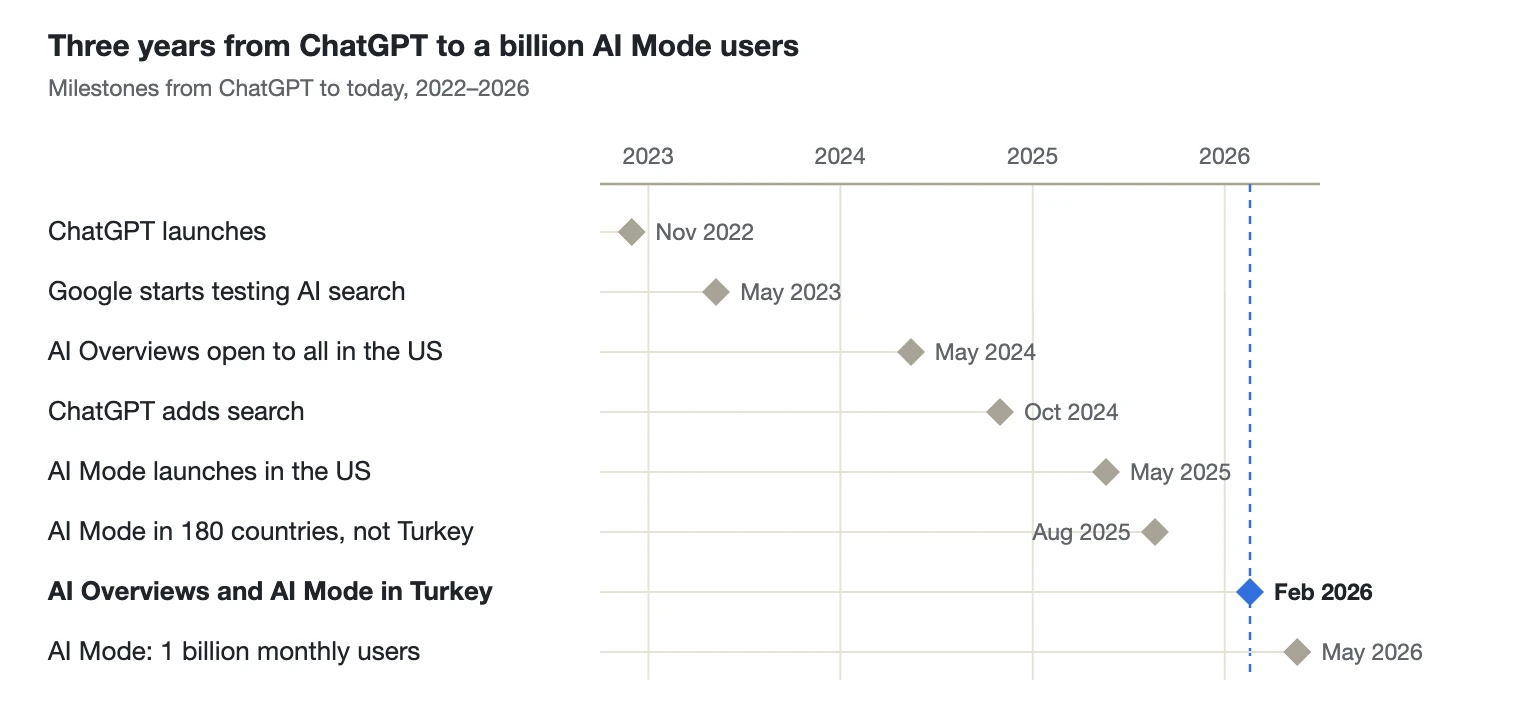
From ChatGPT’s launch to AI Mode opening in Turkey, about three years passed; the last two were spent with Google rebuilding search.
4. What do the numbers say?
According to figures Google shared in May 2026, more than 2.5 billion people use AI Overviews every month and more than 1 billion use AI Mode. The Gemini app has passed 900 million monthly users (Google I/O 2026).
OpenAI announced in February 2026 that ChatGPT had reached 900 million weekly active users (TechCrunch). Perplexity, Copilot and Claude are also places where some of these people look for information.
Of course, not all of these users are looking for a product or a service. Many use ChatGPT to write, fix code or translate. But a large share of them now ask an AI the question they would once have typed into Google.
The way we ask is changing too. According to Google’s own data, searches in AI Mode are two to three times longer than traditional queries (Google). On Google we typed short phrases: “packaging machine”, “dental implant price”. With AI, we describe our situation as if we were talking to an expert.
5. The same need, two different searches
There is a situation we see often with our B2B clients. Keyword tools show us generic queries like “packaging machine”. But the sales team gets much more specific questions from customers every day: “Can this machine fill foaming products?”, “Which cities do you have service in?”, “How many days does a spare part take?”
In traditional search, this user typed “liquid filling machine” into Google. They saw manufacturer sites, listing sites and maybe a guide. They visited five or six sites, built their own shortlist, then called the two or three companies that looked right and asked for a quote.
Today the same person can write this to ChatGPT:
“We will fill 3,000 bottles of liquid soap a day. The product foams and our budget is around €25,000. Which manufacturers with local service should I look at?”
This time they don’t get ten links. They get a shortlist of three or four companies, each with a reason why it fits. Some have a source link, some don’t. In the next message the user asks “Which of these has the wider service network?” and narrows the list even further.
Look at the information the user gives: daily capacity, a product property, budget, country, service needs. We call these constraints. AI uses all of them to answer.
If your site doesn’t say “suitable for foaming products”, if you don’t state the capacity clearly, if your service network is not described anywhere, it becomes harder to get on that list even if you make the best machine. In traditional SEO this information was seen as “nice to have”. In AI search it can decide whether you make the list at all.
6. AI now builds the shortlist
I think this is the most important sentence of this chapter: The shortlist is no longer built by the user, but by AI.
In traditional search, if the user saw you on page one, there was a chance they would at least visit your site, even if it was a little slow or your product page was a bit thin. They did the comparison themselves and gave you a chance in that comparison.
In AI search, a large part of that comparison happens before the user sees anything. If AI evaluates ten companies and shows three, the other seven never appear in front of the user. If you are not on that list, the user can decide without ever seeing you.
There is a good side to this too. When you make the list, the user comes to you much more ready.
7. Search is no longer a single query, it is a conversation
In traditional search, every search stood on its own. The user typed “liquid filling machine”, looked at the results, then ran a new search: “liquid filling machine price”. Google mostly treated each search as a separate question.
In AI search, the user continues in the same conversation. After the first answer they ask “Which of these runs more quietly?”, “Are spare parts for the second one easy to find?”, “Can you compare them in a table?” Each new question builds on the previous one.
This tells us two things.
First, being in the first answer may not be enough. The user narrows the list with every question. If your name appears in the first list but drops out at the “service network” question, you are not on the list at the moment of decision. So we need to think not only about the first question but also about the follow-up questions the user asks while deciding. Most of them are questions your sales team already answers every day.
Second, the same question does not give everyone the same answer. ChatGPT can remember the user from previous conversations. In January 2026 Google announced Personal Intelligence for AI Mode; if the user allows it, AI Mode can also use information from Gmail and Google Photos to answer (Search Engine Journal). For now it is limited to the US and paid subscribers, but the direction is clear.
In traditional search, not everyone saw the same results either. Location, language, device and search history changed them. But in AI search the difference is much bigger. Even if two people type the same sentence, one person’s previous conversations, company, budget and preferences can change the answer. And the same person asking the same question twice can get a different answer.
That is why “I asked ChatGPT and it didn’t show us” means little on its own. Drawing a conclusion from asking a question once is like checking a keyword’s ranking once, on one day, from one computer. In Chapter 7 we will look at how to measure visibility while accounting for this variability.
8. Why are visitors from AI more valuable?
What we see with our clients shows this very clearly.
Traffic from AI platforms is generally below 10% of total site traffic today. So in volume it is still small. But these visitors convert to sales at around 6–7%. Considering that the overall conversion rate in e-commerce is around 1%, that is a serious difference.
I think the reason is simple. The user does most of their research while talking to the AI. They ask about options, compare them, raise their objections. When they reach your site, they are no longer at the “let me look around” stage but at the “this could be it” stage.
In traditional search, a user might visit five different pages of yours in five different searches before deciding. Some of those were informational visits that naturally lowered the conversion rate. In AI search, many of those in-between visits stay inside the conversation. The visit you get is the one closest to the decision.
I draw two conclusions from this:
- AI traffic should be judged by its value, not its volume. A channel that looks like 3% of total traffic may be bringing a much larger share of sales.
- Your sales may not fall while informational traffic does. Before panicking at a traffic chart, look at conversions, revenue and the quality of incoming leads.
Of course these numbers vary by industry, product and site. But seeing the same trend across clients in different industries is not a coincidence, in my view. In Chapter 8 we will cover in detail how to separate and correctly measure this traffic in Analytics.
9. They see you on ChatGPT and search for you on Google
The 6–7% conversion rate above is actually the part we can see. A significant part of AI’s influence does not show up as AI in Analytics.
Picture this. A purchasing manager asks ChatGPT about filling machines and sees your brand on the list. They don’t click the link. In the evening they sit at their computer, type your brand name into Google and visit your site from there. Or the next day they type your address directly. A week later they call and ask for a quote.
In Analytics this visit appears as branded organic search or direct traffic. The quote lands in the CRM as “phone”. The AI answer that started the decision is in no report.
Something similar existed in traditional SEO. A user could read one of your blog posts and come back months later by searching your brand. But in AI search this is much more common, because the user gets the answer and doesn’t feel the need to click.
So we should not look for the results of AI visibility only in AI-referred traffic. I think three things should be watched together:
- Branded searches: Is the number of queries containing your brand growing in Search Console?
- Direct traffic: Are direct visits growing, especially to quote and contact pages?
- “How did you hear about us?”: Add this question to your quote form and sales calls, and include ChatGPT and other AI tools as options.
The last one is the simplest but, in my opinion, the most valuable. The customer can tell you what Analytics can’t see.
We will cover this in detail in Chapter 8 with the distinction between “observed”, “estimated” and “modelled” impact. For now, let’s keep one thing in mind: AI traffic looking small does not mean AI’s influence is small.
10. Where does AI find this answer?
I will explain this in detail in Chapter 3, but it helps to know the basic logic now.
AI has two sources of information. The first is its training data. Over the years the model learns from countless texts written on the internet and forms an impression of your brand. The second is live search. If the question needs up-to-date information, the model searches, reads the pages it finds and writes the answer based on those pages.
Google explains this second process clearly in its own guide (Google Search Central). AI Overviews and AI Mode ground their answers in pages from Google’s search index. This is called Retrieval-Augmented Generation (RAG): generating answers fed by sources.
There is also query fan-out. AI does not run your long question as a single search; it splits it into several smaller searches. It runs searches like “foaming liquid filling machine”, “filling machine prices” and “filling machine manufacturers” in the background and combines the results.
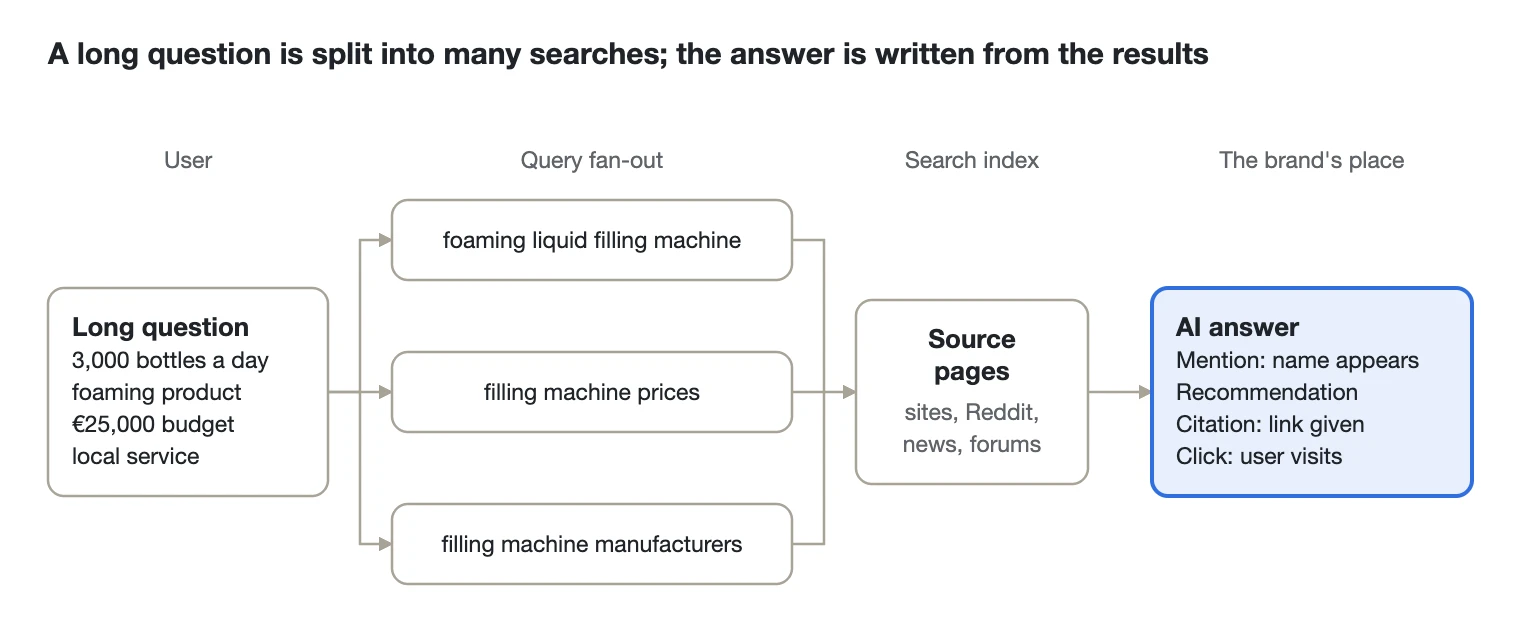
This tells us something very important: If you are not crawled, not indexed and cannot be found for the related searches on Google, it is very hard to become a source in AI Overviews. The foundation of crawling, indexing and ranking still applies in AI search. I will summarize that foundation briefly in Chapter 2.
ChatGPT, Perplexity and Copilot work in a similar way when they search live. Which search infrastructure they use and how they show sources differ. We will go through that platform by platform in Chapter 4.
11. The cited sources are not always the top 10
If AI Overviews write their answers from pages in Google’s index, the first question that comes to mind is: are the cited pages simply the ones already in the top 10?
Ahrefs looked at this twice. In its study published in July 2025, about 76% of the pages cited in AI Overviews ranked in the top 10 for the same query (Ahrefs). In its March 2026 study, based on 863,000 queries and about 4 million cited URLs, that share fell to 37.9% (Ahrefs). About 31% of the sources were not even in the top 100.
Ahrefs notes that it improved its methodology between the two studies, so the comparison is not one-to-one. AI Overviews also moved to the Gemini 3 model in that period. But the trend is very clear.
Ahrefs’ interpretation makes sense to me: Google now picks sources not only from the results of the query the user typed, but also from the results of the sub-queries it generates through query fan-out. The user asks about a “foaming liquid filling machine”, but the cited page may be one that does well for “what is a diving nozzle”.
In practice this means two things.
Ranking in the top 10 for the main keyword is no longer enough on its own. Your page also needs to give clear answers to the sub-questions users ask while deciding. If capacity, suitable product types, service area, delivery time and which model fits which case are clearly written on the page, your chance of being a source for one of the sub-queries increases.
But creating a separate page for every sub-question is not the solution. Google states clearly that producing a separate page for every query fan-out variation can fall under its scaled content abuse policy (Google Search Central). The right approach is well-organized pages that cover a topic in all the aspects users really care about.
One more thing: in Ahrefs’ data, a significant share of the cited pages that were not in the top 100 were YouTube videos. So AI doesn’t only read web pages. A good video explaining your product can also make you a source. We will cover this in Chapter 14 together with third-party sources.
12. Being mentioned, recommended, cited and clicked are not the same thing
In traditional search, a page either ranked or it didn’t. If it ranked, we knew its position.
In AI answers, there are four very different ways a brand can appear. Let’s use the filling machine example:
- Mention: Your brand name appears in the answer. But maybe just in passing: “There are manufacturers such as X, Y and Z.”
- Recommendation: AI actually recommends you. It says “For foaming products, X’s diving nozzle model looks more suitable, because…”
- Citation: Part of the answer is based on your page and links to it.
- Click: The user clicks that link and comes to your site.
Each of these points to a different problem.
If your name appears but you are not recommended, perhaps a feature that sets you apart from competitors is not explained anywhere. If you are recommended but not cited, AI may be learning about you not from your own site but from elsewhere, such as a listing site or a forum. If you are cited but not clicked, the user may have already received what they needed in the answer.
And there is a fifth case, which I think is the most dangerous: AI recommends you but describes you incorrectly. It recommends a model you no longer make, quotes your old price, says you have service in a city where you don’t, or confuses you with a competitor. That kind of visibility has very limited value for the business and can even do harm. When the user calls you and asks for that model, the first conversation starts with a disappointment.
That is why, throughout this book, we will not treat “Does ChatGPT show us?” as enough on its own. Visibility needs to be measured separately at each of these layers. Chapter 7 is entirely about this.
13. Not every question is affected the same way
The impact of AI search varies a lot depending on the type of question. I think the easiest way to understand it is to group questions by what the user does after getting the answer:
| Question type | Example | What happens after the answer? |
|---|---|---|
| Quick fact | “How many cm is an inch?” | Usually ends in the answer, no visit to a site |
| Explanation and how-to | “How do I increase boiler pressure?” | Simple ones end in the answer; those needing detail and visuals still bring visits |
| Comparison and decision | “Which filling machine for a foaming product?” | AI builds a shortlist, the user goes to the brands on it |
| Purchase and transaction | “Where is brand X vacuum cleaner cheapest?” | The user still comes to a site to buy |
| Local | “Dentist open in the evening near Sultanahmet” | Maps, reviews and the Business Profile come to the front |
| Brand | “imza.com” | The user is already looking for you and comes to your site |
This table tells us that the most affected content is informational content whose answer fits in a single paragraph. A large part of the content produced for years with the logic of “This keyword gets a lot of searches, let’s write a blog post” falls into this group.
In comparison and decision questions, the game changes but does not end. Here the point is less about protecting traffic and more about getting on the shortlist. In purchase and brand searches, the user still has to come to your site. At least for now. We will discuss shopping agents, which can buy on the user’s behalf, in Chapter 15.
14. The answer itself is changing: ads and agents
When AI answers first appeared, they looked like a purely organic summary. Now this space is quickly becoming commercial too.
In its Turkey announcement, Google notes that ads continue to appear in specific areas on AI Overviews and AI Mode pages (Webrazzi). OpenAI announced in January 2026 that it had started testing ads in ChatGPT (MarketScreener). For now they are shown in the US, to users on the free and Go plans, below the answer and labeled as ads. OpenAI says ads will not influence the answers.
The distinction I think matters here is this: you can buy an ad and appear below the answer, but you cannot buy AI recommending you inside the answer. In traditional search, ads and organic results were separate too. The same separation continues here, and this book is about the organic part.
The bigger change is coming from agents. Google held its May 2026 I/O conference under the theme of “the agentic era” (Google I/O 2026). In its own guide, it advises site owners to prepare for browser agents and to follow new protocols such as the Universal Commerce Protocol (UCP) (Google Search Central).
By an agent we mean this: the user says “Find me a suitable filling machine and ask three manufacturers for a quote.” The AI browses the sites, fills in the forms and does the comparison. The user may never see your site; your site is read by an agent.
This is not widespread yet, and no one knows exactly how long it will take for a B2B buying process like this to take shape. But we can already say this: sites that hide prices in PDFs, technical specifications in images and contact details behind complicated forms will be at a disadvantage both in AI answers and in the eyes of agents. In Chapter 15 we will cover making commercial data machine-readable and shopping agents in detail.
15. Are clicks really falling?
This is the question SEOs ask most.
In 2025, Pew Research Center analyzed the real browsing data of 900 adults in the US (Pew Research). In searches with an AI summary at the top, users clicked a traditional result 8% of the time. In searches without a summary, the rate was 15%. Clicks on links inside the summary were only 1%. In addition, users ended their session without clicking anywhere in 26% of searches with a summary, compared with 16% without one.
So a user looking for information may not visit a site once they get their answer.
With our clients, the picture is calmer. After AI Overviews opened in Turkey, none of our clients saw a serious drop in clicks. But we do see small declines and we track them closely.
There may be a few reasons for this. The feature is still new in Turkey and rolling out gradually. Many of our clients are in e-commerce and B2B; most of their traffic comes from purchase and decision queries, which the table above shows are less affected. For a blog or a dictionary site that gets traffic from informational content, the picture could be very different.
My suggestion: split clicks in Search Console by page type. Track blog, category, product and brand queries separately. The overall traffic chart may not show you the truth; a decline may be concentrated in one group of pages while others grow.
16. So is SEO over?
No. And I am not the only one saying so.
In the guide it published in 2026, Google is very clear: from its perspective, optimizing for generative AI search is optimizing for the search experience, and that is still SEO (Google Search Central). The same guide says you don’t need a special llms.txt file, special Schema markup or to break your content into chunks for AI. It also reminds us that creating separate pages for every query variation can violate its spam policies.
On the traffic side, things are not as dramatic as they are often presented either. In April 2026, Aleyda Solis analyzed Semrush data for 40 large US sites in four industries (Aleyda Solis). On these sites, about 20.45% of visits came from organic search and 0.19% from AI platforms. So in this sample, organic search traffic was about 108 times AI traffic. With our clients, AI’s share of traffic is higher, but still small next to organic search.
I think the right sentence is this: AI search is growing fast and changing the decision process. But traditional search is still very large, and both stand on the same foundation.
We heard “SEO is dead” when social media arrived, when mobile came, when voice search was the hot topic. SEO didn’t die; it changed. This time the change is bigger, that’s all.
17. What stayed the same, and what changed?
What stayed the same:
- Google must be able to crawl and index your page.
- Your page must actually answer the user’s question.
- Content needs to be trustworthy, original and based on experience.
- Brand and authority still matter.
- Search intent is still at the center.
What changed:
- The definition of success: Not just rankings and clicks, but being recommended, being described correctly and getting on the shortlist.
- The shape of the question: Alongside short keywords, long, personal questions with constraints.
- The weight of sources: AI learns about you not only from your site, but also from Reddit, YouTube, review sites, the news and your competitors’ comparison pages.
- The role of content: Informational content whose answer fits in a paragraph is losing traffic value. Content that helps people decide, such as comparisons, pricing, calculators, real tests and case studies, is gaining value.
- The value of traffic: Fewer visitors, but closer to a decision.
- Measurement: There is no data as clear as Search Console. The same question can give a different answer each time, and each platform behaves differently.
18. What will we do in this book?
I always say that in SEO, instead of promising results, you have to manage the process. In AI search this is even more true. “We will get you to number one on ChatGPT” doesn’t fit the nature of this work, in my view. There isn’t even such a thing as number one.
Instead, we will build a measurable system:
- We will decide which questions we want to appear in.
- We will measure how we appear today.
- We will diagnose why we don’t appear, or why we are described incorrectly.
- We will fix the content, technical, brand or third-party source problem.
- We will measure the same questions again.
In the first part of the book we will understand how search has changed and how AI works. In the second part we will look at what to measure; in the third, the technical foundation; in the fourth, content and brand; in the fifth, commerce and industries. Then we will turn all of this into a system that runs continuously, and in the last part we will look at using AI in SEO work itself.
One warning: this field is changing very fast. Think of this book as the “2026 edition”. Platform features, numbers and tools will change, which is why I will keep the web version continuously updated. But I believe the logic of how AI gets to know a brand, what it trusts and what it recommends to users will stay valid for much longer.
Checklist
- Write down the 10 questions closest to a sale. In the way users would really ask them, with their constraints. Ask your sales team: “What do customers ask most?”
- Ask these questions in ChatGPT, Gemini and Google AI Mode. For each, note whether your brand is mentioned, recommended and linked, in a table like the one below.
- Check whether there is wrong or outdated information about your brand. Prices, products, service areas and contact details come first.
- In Analytics, separate traffic from sources such as chatgpt.com, perplexity.ai, gemini.google.com and copilot.microsoft.com, along with its conversion rate.
- In Search Console, split clicks by page type (blog, category, product, brand) and compare the last six months.
- Check that your important pages are indexed on Google. If the foundation is weak, you will struggle on the AI side too.
A simple table is enough for the first measurement:
| Question | Platform | Mentioned? | Recommended? | Linked? | Accurate? | Which competitors appear? |
|---|---|---|---|---|---|---|
| Filling machine for a foaming product | ChatGPT | |||||
| Filling machine for a foaming product | AI Mode |
Sources
- Google I/O 2026: Welcome to the agentic Gemini era (May 19, 2026)
- Google Search Central: Optimizing for generative AI search (last updated July 10, 2026)
- Google: AI-powered search innovation takeaways (February 6, 2026)
- Webrazzi: Google starts rolling out AI Mode and AI Overviews in Turkey (Turkish, February 18, 2026)
- Forbes Türkiye: Google’s AI Mode opens in 180 countries, excluding Turkey (Turkish, August 22, 2025)
- Search Engine Journal: Google launches Personal Intelligence in AI Mode (January 22, 2026)
- TechCrunch: ChatGPT reaches 900M weekly active users (February 27, 2026)
- MarketScreener: OpenAI introduces advertising in ChatGPT for US users (January 16, 2026)
- Pew Research Center: Google users are less likely to click on links when an AI summary appears (July 22, 2025)
- Ahrefs: 76% of AI Overview citations rank in the top 10 (July 21, 2025)
- Ahrefs: AI Overview citations and the top 10 (March 2, 2026)
- Aleyda Solis: AI Traffic vs AI Citations (May 27, 2026)
Back to the table of contents · Next: Chapter 2, The SEO Foundation You Need for AI Search